Presentation Announcement: Re-Imagining the Bibliographic Universe -- FRBR, Physics and the World Wide Web

Add this event to your desktop calendar program.
 A PDF of the presentation slides (35MB ZIP file) is now available online.
The presentation is open to the public, and will be from 10am to noon in the Mumford Room (6th floor of the LC Madison Building). The abstract of the talk is:

In response to dramatic increases in the quantity and types of culturally significant resources in libraries, cataloging theories like FRBR (Functional Requirements for Bibliographic Records) have become more complex when compared to traditional cataloging theories. The need to re-conceptualize and justify bibliographic resource description theories is now critical, due to the emergence of the World Wide Web – whose structure and content is more varied and more dynamic than that of libraries. To support the argument that the “commonsense imagery” of analog materials limits our thinking about cataloging and about resource description in general, the speaker will review how for atomic physicists, the “commonsense imagery” of physical processes had to be abandoned in the early 20th Century because the mathematics that explained the measurements of physical processes could no longer be related to any perceivable object or event. The diagrams that have fueled physicist’s imagination since 1945 correspond to nothing in the physical world – but were instead generated by the theories created by the physicists. The speaker suggests that the complexity of analog and digital Cultural Heritage resources warrants a similar approach to their description. This approach – "Paper Tool" creation and use – applies equally well to bibliographic descriptions of library content as well as to the emerging Semantic Web.
I've been privileged to watch Ron's work unfold over the past few months, and what he has created is a compelling abstract model for handling the interrelated nature of bibliographic data with FRBR structures. FRBR tells us that bibliographic data contains more complexity than flat MARC records can allow, and Ron's paper tools shows us graphical evidence of that complexity. And not only the challenges that such complexity suggests, but also the benefits we gain by tackling that complexity head on. Just to give you a taste, his modeling technique describes the various works, expressions, manifestations, and items of Pippi Longstocking like this: 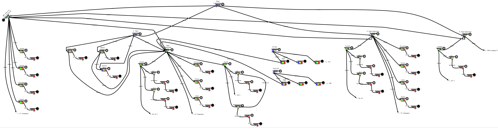
Although I won't be able to attend the presentation in person, I understand that a recording will be made available later. Even so, if you are in the Washington DC area next Monday, I strongly suggest that you attend Ron's presentation to get the full effect of his presentation of the model and the ability to ask questions.
The presentation flyer also contains this information: Request ADA accommodations five business days in advance by contacting (202) 707-6362 or ADA@loc.gov. For more information about this program, contact Angela Kinney (anki@loc.gov) or Judith Cannan (jcan@loc.gov).
The text was modified to remove a link to http://files.me.com/kandroma1/nnwy9z on May 17th, 2011.
The text was modified to update a link from http://www.loc.gov/z3950/agency/dc/madison.html to http://myloc.gov/ExhibitSpaces/madisonbuilding/Pages/default.aspx on November 13th, 2012.