One Year of Learning 2025
Inspired by Tom Whitwell's 52 things I learned in 2022, I started my own list of things I learned in 2023 and repeated it last year. Reaching the end of another year, it is time for Things I Learned In 2025. Part way through the year I had the brilliant idea of putting a learning at the bottom of my weekly newsletter, and that worked well until the middle of the year when I stopped publishing newsletter issues. So here is a half year of learnings.
What did you learn this year? Let me know on Mastodon or Bluesky.
In Ethiopia, time follows the sun like nowhere else
Because Ethiopia is close to the Equator, daylight is pretty consistent throughout the year. So many Ethiopians use a 12-hour clock, with one cycle of 1 to 12 — from dawn to dusk — and the other cycle from dusk to dawn. Most countries start the day at midnight. So 7:00 a.m. in East Africa Time, Ethiopia's time zone, is 1:00 in daylight hours in local Ethiopian time. At 7:00 p.m., East Africa Time, Ethiopians start over again, so it's 1:00 on their 12-hour clock.
This could have easily gone in the Thursday Threads on time standards. There are 12 hours of daylight, numbered 1 through 12. Then 12 hours of night, numbered 1 through 12. What could be easier?
From Thursday Threads issue 104 on Long Term Digital Storage.
A biographer embedded with the Manhattan Project influenced what we think about the atomic bomb
In early 1945, a fellow named Henry DeWolf Smyth was called into an office in Washington and asked if he would write this book that was about a new kind of weapon that the US was developing. The guy who had called him into his office, Vannevar Bush, knew that by the end of the year, the US was going to drop an atomic bomb that had the potential to end the war, but also that as soon as it was dropped, everybody was going to want to know what is this weapon, how was it made, and so forth. Smyth accepted the assignment. It was published by Princeton University Press about a week after the bomb was dropped. It explained how the US made the bomb, but it told a very specific kind of story, the Oppenheimer story that you see in the movies, where a group of shaggy-haired physicists figured out how to split the atom and fission, and all of this stuff. The thing is, the physics of building an atomic bomb is, in some respects, the least important part. More important, if you actually want to make the thing explode, is the chemistry, the metallurgy, the engineering that were left out of the story.
The quote above comes from the transcript of this podcast episode. I've thought about this a lot in the past week as the Trump administration's flood-the-zone strategy overwhelms the senses. In a valiant effort to cover everything that is news, I can't help but wonder about the lost perspective of what isn't being covered. And I wonder where I can look to find that perspective.
From Thursday Threads issue 105 on Facial Recognition.
The origin of the computer term "mainframe" comes from "main frame" — the 1952 name of an IBM computer's central processing section
Based on my research, the earliest computer to use the term "main frame" was the IBM 701 computer (1952), which consisted of boxes called "frames." The 701 system consisted of two power frames, a power distribution frame, an electrostatic storage frame, a drum frame, tape frames, and most importantly a main frame.
"Mainframe" is such a common word in my lexicon that it didn't occur to me that its origins was from "main frame" — as in the primary frame in which everything else connected. I've heard "frame" used to describe a rack of telecommunications equipment as well, but a quick Kagi search couldn't find the origins of the word "frame" from a telecom perspective.
From Thursday Threads issue 106 on How much do you know about the credit card industry?.
It takes nearly 3¢ to make a penny, but almost 14¢ to make a nickel
FY 2024 unit costs increased for all circulating denominations compared to last year. The penny’s unit cost increased 20.2 percent, the nickel’s unit cost increased by 19.4 percent, the dime’s unit cost increased by 8.7 percent, and the quarter-dollar’s unit cost increased by 26.2 percent. The unit cost for pennies (3.69 cents) and nickels (13.78 cents) remained above face value for the 19th consecutive fiscal year
I knew pennies cost the U.S. mint more than one cent to make, but I didn't realize that the cost of nickels is so much more out of whack. I also learned a new word: seigniorage — the difference between the face value of money and the cost to produce it.
From Thursday Threads issue 107 on the humble battery. Also this year, the U.S. mint stopped pressing pennies in November.
It is much harder to get to the Sun than it is to Mars
The Sun contains 99.8 percent of the mass in our solar system. Its gravitational pull is what keeps everything here, from tiny Mercury to the gas giants to the Oort Cloud, 186 billion miles away. But even though the Sun has such a powerful pull, it’s surprisingly hard to actually go to the Sun: It takes 55 times more energy to go to the Sun than it does to go to Mars.
I suppose it that headline above needs some nuance. It is easy to get to the Sun...just escape Earth's gravity and point yourself there. It is hard to get to the Sun in a controlled way that means you won't burn up along the way.
From Thursday Threads issue 108 on Educational Technology.
There are now 23 Dark Sky Sanctuaries in the World
Rum, a diamond-shaped island off the western coast of Scotland, is home to 40 people. Most of the island — 40 square miles of mountains, peatland and heath — is a national nature reserve, with residents mainly nestled around Kinloch Bay to the east. What the Isle of Rum lacks is artificial illumination. There are no streetlights, light-flooded sports fields, neon signs, industrial sites or anything else casting a glow against the night sky. On a cold January day, the sun sets early and rises late, yielding to a blackness that envelopes the island, a blackness so deep that the light of stars manifests suddenly at dusk and the glow of the moon is bright enough to navigate by.
The pictures that accompany this article from the New York Times are stunning (gift link). And to think that there are only 23 places in the world that have reached this level of commitment to the environment.
From Thursday Threads issue 109 on Generative AI in Libraries.
Mexico has only one gun store for the entire country
Mexico notes that it is a country where guns are supposed to be difficult to get. There is just one store in the whole country where guns can be bought legally, yet the nation is awash in illegal guns sold most often to the cartels.
And not only is there one gun store, the single store in Mexico is located on an army base and is run by soldiers, according to an article in the Associated Press from 2016.
From Thursday Threads issue 110 on Research into Generative AI.
Plants reproduce by spreading little plant-like things
This is where pollen comes in. Like sperm, pollen contains one DNA set from its parent, but unlike sperm, pollen itself is actually its own separate living plant made of multiple cells that under the right conditions can live for months depending on the species... So this tiny male offspring plant is ejected out into the world, biding its time until it meets up with its counterpart. The female offspring of the plant, called an embryosac, which you're probably less familiar with since they basically never leave home. They just stay inside flowers. Like again, they're not part of the flower. They are a separate plant living inside the flower. Once the pollen meets an embryosac, the pollen builds a tube to bridge the gap between them. Now it's time for the sperm. At this point, the pollen produces exactly two sperm cells, which it pipes over to the embryosac,
which in the meantime has produced an egg that the sperm can meet up with. Once fertilized, that egg develops into an embryo within the embryosac, hence the name, then a seed and then with luck a new plant. This one with two sets of DNA.
From Thursday Threads issue 111 on End-to-end Encryption.
Most plastic in the ocean isn't from littering, and recycling will not save us
Littering is responsible for a very small percentage of the overall plastic in the environment. Based on this graph from the OECD, you can see littering is this teeny-tiny blue bar here, and mismanaged waste, not including littering, is this massive one at the bottom. Mismanaged waste includes all the things that end up either in illegal dump sites or burned in the open or in the rivers or oceans or wherever. The focus on littering specifically, it's an easy answer because obviously there's nothing wrong with discouraging people from littering, but it focuses on individual people's bad choices rather than systemic forces that are basically flushing plastic into the ocean every minute. Mismanaged waste includes everything that escapes formal waste systems. So they might end up dumped, they might end up burned, they might end up in the environment.
Contrary to popular belief, most plastic in the Great Pacific Garbage Patch stems from the fishing industry, with only a small fraction linked to consumer waste. The video highlights that mismanaged waste, rather than individual littering, is the primary contributor to plastic pollution, with 82% of macroplastic leakage resulting from this issue. It emphasizes the ineffectiveness of recycling as a solution, noting that less than 10% of plastics are currently recycled, and the industry has perpetuated the myth that recycling can resolve the plastic crisis. Microplastics, which are increasingly recognized as a major problem, originate from various sources, including tires and paint, with new data suggesting that paint is a significant contributor.
From Thursday Threads issue 112 on Social Media Research.
"But where is everybody?!?" — the origins of Fermi's Paradox
The eminent physicist Enrico Fermi was visiting his colleagues at Los Alamos National Laboratory in New Mexico that summer, and the mealtime conversation turned to the subject of UFOs. Very quickly, the assembled physicists realized that if UFOs were alien machines, that meant it was possible to travel faster than the speed of light. Otherwise, those alien craft would have never made it here. At first, Fermi boisterously participated in the conversation, offering his usual keen insights. But soon, he fell silent, withdrawing into his own ruminations. The conversation drifted to other subjects, but Fermi stayed quiet. Sometime later, long after the group had largely forgotten about the issue of UFOs, Fermi sat up and blurted out: “But where is everybody!?”
This retelling of the Fermi Paradox coms from this story about why, despite the vastness of the universe, we have yet to encounter evidence of extraterrestrial civilizations. Enrico Fermi famously posed the question, "Where is everybody?" suggesting a disconnect between the expectation of abundant intelligent life and the lack of observable evidence. With this comes the Great Filter notion...proposing that there may be significant barriers preventing intelligent life from becoming spacefaring. The article goes on to speculate where we are relative to the "Great Filter" — are we past it, or is it yet in front of us? In other words, have we survived the filter or is our biggest challenge ahead of us?
From Thursday Threads issue 113 on Copyright and Foundational AI Models.
The pronoun "I" was capitalized to distinguish it from similarly typset letters
In fact, the habit of capitalizing “I” was also a practical adaptation to avoid confusion, back in the days when m was written “ııı” and n was written “ıı.” A stray “i” floating around before or after one of those could make the whole thing hard to read, so uppercase it went. And now it seems perfectly logical.
I'm not buying the opinion author's underlying premise (capitalizing “they” in writing when it refers to a nonbinary person), but the origins of why we capitalize "I" and not other pronouns are fascinating.
From Thursday Threads issue 114 on Digital Privacy.
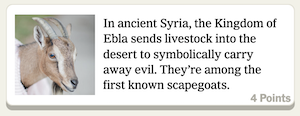
The word "scapegoat" originated in a 1530 bible translation
Early English Christian Bible versions follow the translation of the Septuagint and Latin Vulgate, which interpret azazel as "the goat that departs" (Greek tragos apopompaios, "goat sent out", Latin caper emissarius, "emissary goat"). William Tyndale rendered the Latin as "(e)scape goat" in his 1530 Bible. This translation was followed by subsequent versions up through the King James Version of the Bible in 1611: "And Aaron shall cast lots upon the two goats; one lot for the Lord, and the other lot for the scapegoat."
From Thursday Threads issue 115 on Public and Private Camera Networks.
"Leeroy Jenkins!!!!" was staged
It was one of the first memes ever, a viral sensation that went mainstream back when people still used dial-up internet. Yet the cameraman behind “Leeroy Jenkins” still seems stupefied that anyone fell for it.
First posted on May 10, 2005, this year marks the 20th anniversary of this bit of internet folklore. I remember when this first came out, and I totally believed it was real until earlier this year.
From Thursday Threads issue 116 on Government Surveillance.
Ammonium chloride may be the 6th basic taste
Ammonium chloride is a slightly toxic chemical most notably found in “salmiak,” a salt licorice candy, which is popular in northern Europe. In a new study, researchers found that the compound triggers a specific proton channel called OTOP1 in sour taste receptor cells, which fulfills one of the key requirements to be considered a primary taste like sweet, salty, sour, bitter, and umami. Ammonium is commonly found in waste products and decaying organic matter and is slightly toxic, so it makes sense that vertebrates evolved a specific taste sensor to recognize it.
From Thursday Threads issue 117 on Local Government Surveillance.