- These list items are microformat entries and are hidden from view.
- https://dltj.org/article/drivethru-textbook-buyback/
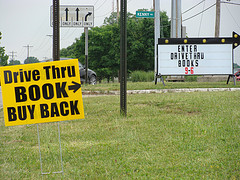
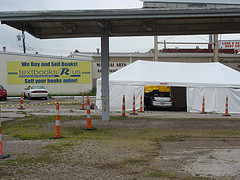
- I continue to be astonished by how efficient the used textbook market has become. This week, at the end of the spring quarter at Ohio State University, a drive-thru textbook buy-back service popped up on the site of a long-closed gas station. It is a tent on a parking lot that truly does allow someone to drive through to drop off books (see the third image down). The operation is run by <a href="http://budgetext.com/svc.coll.buyback.htm" "Budgetext Buyback Program" title="http://budgetext.com/svc.coll.buyback.htm">Budgetext</a>, a national textbook wholesaler from Fayetteville, AR. I spoke with company representative Jerry Mohr about the service.
- 2009-06-12T00:32:20+00:00
- 2018-01-15T20:47:28+00:00
Drive-Thru Textbook Buy-Back
I continue to be astonished by how efficient the used textbook market has become. This week, at the end of the spring quarter at Ohio State University, a drive-thru textbook buy-back service popped up on the site of a long-closed gas station. It is a tent on a parking lot that truly does allow someone to drive through to drop off books (see the third image down). The operation is run by Budgetext, a national textbook wholesaler from Fayetteville, AR. I spoke with company representative Jerry Mohr about the service.
[caption id="attachment_1015" align="alignright" width="244" caption="Images here link to larger versions in Flickr"]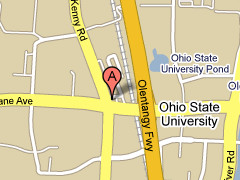
 [/caption]
Budgetext is partnered with Student Book Exchange (SBX) to bring this first-in-Columbus service to Ohio State. Budgetext services the textbook wholesaling needs of SBX. Since Budgetex has the list of textbooks through SBX that are needed for the next school term, it can more intelligently buy back the books that will be needed. Jerry said that most of the books bought back through the drive thru service will stay in the area, with the remainder wholesaled through their national network.
It is hard to beat the convenience. One literally drives up, hands the books over, and gets the cash back (or the book back if it is not needed by Budgetext). On a day like today in Columbus -- with the downpour this morning and this afternoon -- that process certainly seems to beat lugging the books to a desk inside a bookstore.
Although this is the first drive-through in central Ohio, it is not the first such setup in the state. A drive-through program was set up at Owens Community College in northwest Ohio two years ago. Jerry told me that in its first 4 1/2 days of operation, 500 cars came through. The following term 1,500 cars came through. All kinds of people come through -- parents with kids, handicapped individuals, even multiple students in one car. Jerry said that one car last year had three students: one each from Owens Community College, the University of Toledo, and Bowling Green State University. It is still too early to tell how well the service will do in this location.
The impact of these improved efficiencies in the used textbook market makes the textbook ecosystem even more complicated. It is capitalism at its finest, but I'm not sure this present trajectory is sustainable.
