- These list items are microformat entries and are hidden from view.
- https://dltj.org/article/outsource-digital-bits/
- A colleague forwarded an article from The Register with news of a new service from Iron Mountain for Cloud-Based File Archiving. It is billed as a "storage archiving service designed to help companies reduce costs of storing and managing static data files." My place of work is facing an increasing need large-scale digital preservation storage with the acquisition of a large collection of music and the conversion of our educational videos from physical DVD preservation to digital preservation. We're talking terabytes of content that is we need to keep in its archival form -- uncompressed, high quality media files (not the lower quality, derivatives for day-to-day access). It doesn't make sense to keep that on expensive SAN storage, of course, so this article struck me at just the right time to consider alternatives.[caption id="attachment_801" align="alignnone" width="779" caption="Architecture Diagram for Iron Mountain\'s Virtual File Store service, showing the placement of the Virtual File Store appliance relative to other assets on the data center network. Graphic from product datasheet (http://www.ironmountain.com/resources/vfs/virtual_file_store_datasheet.pdf)"][/caption]According to the product literature, the service works by putting a black box on your network where one can drop files via CIFS or NFS. The black box transfers the files over the internet to two Iron Mountain data centers. Files can then be retrieved via an on-line on-demand service or by exchanging physical media with Iron Mountain for bulk retrieval needs.We know, of course, that digital preservation is more than just preserving the digital bits: it is the intellectual exercise of describing the stored information, the effort of maintaining an accurate catalog of that information, and the burden of migrating file formats or emulating platforms to read old file formats. Handling the raw bits is a big deal, too -- checksumming to ensure unaltered status, refreshing files to new storage media, and protection from physical disasters. This Iron Mountain solution seems to address this more mechanical portion of digital preservation, and it one that probably can benefit from aggregating the service needs of many customers (and so is ripe for outsourcing).Is anyone doing something similar with their physical preservation of digital media? Are there other companies that do the same thing? (I know of OCLC's Digital Archive service — I did a comparison of it with Amazon S3 last year.)
- 2009-03-05T19:55:25+00:00
- 2018-01-15T20:47:28+00:00
Can We Outsource the Preservation of Digital Bits?
A colleague forwarded an article from The Register with news of a new service from Iron Mountain for Cloud-Based File Archiving. It is billed as a "storage archiving service designed to help companies reduce costs of storing and managing static data files." My place of work is facing an increasing need large-scale digital preservation storage with the acquisition of a large collection of music and the conversion of our educational videos from physical DVD preservation to digital preservation. We're talking terabytes of content that is we need to keep in its archival form -- uncompressed, high quality media files (not the lower quality, derivatives for day-to-day access). It doesn't make sense to keep that on expensive SAN storage, of course, so this article struck me at just the right time to consider alternatives.
[caption id="attachment_801" align="alignnone" width="779" caption="Architecture Diagram for Iron Mountain\'s Virtual File Store service, showing the placement of the Virtual File Store appliance relative to other assets on the data center network. Graphic from product datasheet (http://www.ironmountain.com/resources/vfs/virtual_file_store_datasheet.pdf)"]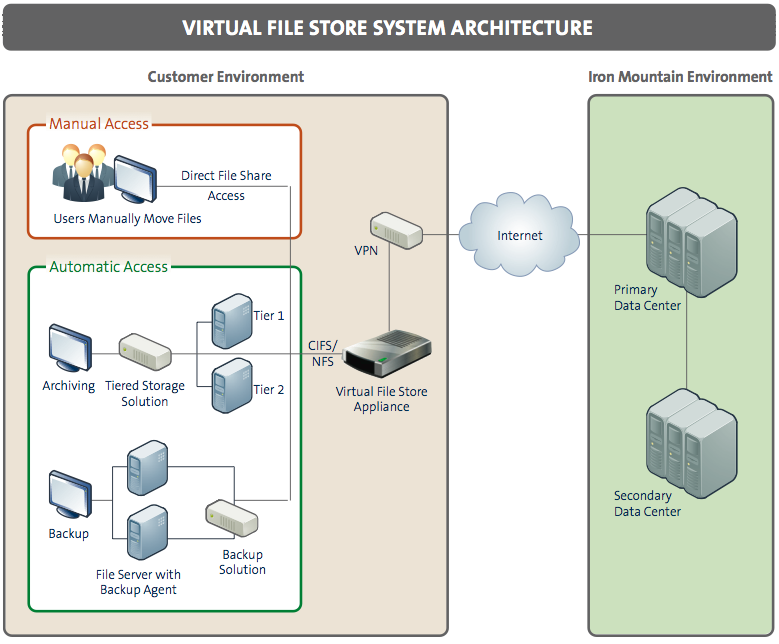 [/caption]
According to the product literature, the service works by putting a black box on your network where one can drop files via CIFS or NFS. The black box transfers the files over the internet to two Iron Mountain data centers. Files can then be retrieved via an on-line on-demand service or by exchanging physical media with Iron Mountain for bulk retrieval needs.
We know, of course, that digital preservation is more than just preserving the digital bits: it is the intellectual exercise of describing the stored information, the effort of maintaining an accurate catalog of that information, and the burden of migrating file formats or emulating platforms to read old file formats. Handling the raw bits is a big deal, too -- checksumming to ensure unaltered status, refreshing files to new storage media, and protection from physical disasters. This Iron Mountain solution seems to address this more mechanical portion of digital preservation, and it one that probably can benefit from aggregating the service needs of many customers (and so is ripe for outsourcing).
Is anyone doing something similar with their physical preservation of digital media? Are there other companies that do the same thing? (I know of OCLC's Digital Archive service — I did a comparison of it with Amazon S3 last year.)
