- These list items are microformat entries and are hidden from view.
- https://dltj.org/article/google-is-watching/
- An interesting thing happened at my place of work (OhioLINK) today. We recently added links to our central catalog pointing to manifestations in Google Books. The way it was decided to set it up, though, was to only point to Google Books if the full text was available. We tweeted about it to let our community know that this option was now available. The tweet included a link to a particular record that showed (at the time) an example of this change: Mark Twain's Life on the Mississippi.Others picked up on the tweet and word got around. This morning I noticed a comment on one of those tweets via FriendFeed -- the link to the full text was no longer visible on our sample record. Odd, I thought, and I started poking around. Other items in our catalog still showed the link to full text in Google Books. And the same record in Kent State University's catalog, using the same linking mechanism, had a link to the item in Google Books, but -- and this is the kicker -- now only in "snippet" view. And that is probably the appropriate view given the copyright date of 1951.What we're guessing is that the book was erroneously in full view mode in Google Books. The large number of hits -- caused by it being the example record in OhioLINK's blog posts and tweets -- triggered some sort of usage alarm at Google Headquarters, where someone (or some algorithm) took a second look at the classification of the item and changed the view from full to snippet.In any case, we tweeted a second example that, given its copyright year of 1918, will most likely remain in full view mode.The text was modified to remove a link to http://search.twitter.com/search?q=OhioLINK+Google+Books on September 26th, 2013.
- 2009-08-27T01:00:54+00:00
- 2018-01-15T20:28:01+00:00
Google’s Watching What We’re Doing – At Least In Aggregate
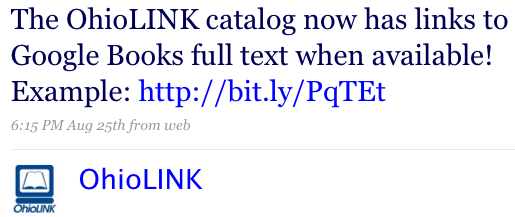 An interesting thing happened at my place of work (OhioLINK) today. We recently added links to our central catalog pointing to manifestations in Google Books. The way it was decided to set it up, though, was to only point to Google Books if the full text was available. We tweeted about it to let our community know that this option was now available. The tweet included a link to a particular record that showed (at the time) an example of this change: Mark Twain's Life on the Mississippi.
Others picked up on the tweet and word got around. This morning I noticed a comment on one of those tweets via FriendFeed -- the link to the full text was no longer visible on our sample record. Odd, I thought, and I started poking around. Other items in our catalog still showed the link to full text in Google Books. And the same record in Kent State University's catalog, using the same linking mechanism, had a link to the item in Google Books, but -- and this is the kicker -- now only in "snippet" view. And that is probably the appropriate view given the copyright date of 1951.
What we're guessing is that the book was erroneously in full view mode in Google Books. The large number of hits -- caused by it being the example record in OhioLINK's blog posts and tweets -- triggered some sort of usage alarm at Google Headquarters, where someone (or some algorithm) took a second look at the classification of the item and changed the view from full to snippet.
In any case, we tweeted a second example that, given its copyright year of 1918, will most likely remain in full view mode.
The text was modified to remove a link to http://search.twitter.com/search?q=OhioLINK+Google+Books on September 26th, 2013.
