- These list items are microformat entries and are hidden from view.
- https://dltj.org/article/doaj-articles/
- Earlier this year the DOAJ began offering a new schema for registered articles that significantly improves the value of OAI-PMH harvested article content. Prior to this addition the only scheme available was Dublin Core, which as a metadata schema for describing article content is woefully inadequate. (Dublin Core, of course, was never designed to handle the complexity of the description of an average article.) The new schema (graphically represented here -- select thumbnail to see a larger version) includes elements for ISSN/eISSN, volume/issue, start/end page numbers, and author affiliation. There is also a </code> element that is a link to the article content itself (not the splash page of the article on the publisher's site).</p>Article content using this schema is harvestable through the DOAJ OAI-PMH provider site (for instance, using a ListRecords verb with a doajArticle metadata prefix against the PMH URL). This is, in fact, the same schema journal publishers use to submit article content to the DOAJ article database. With these pieces in place, it is now conceivable to harvest open access journal article content through the DOAJ and add it to a local journal article repository (such as the Electronic Journal Center in the case of OhioLINK).Thanks go out to the DOAJ folks for making this available!
- 2007-07-11T20:51:54+00:00
- 2018-01-15T20:47:28+00:00
Article-Level OAI-PMH Harvest Available from DOAJ
Earlier this year the DOAJ began offering a new schema for registered articles that significantly improves the value of OAI-PMH harvested article content. Prior to this addition the only scheme available was Dublin Core, which as a metadata schema for describing article content is woefully inadequate. (Dublin Core, of course, was never designed to handle the complexity of the description of an average article.) The new schema (graphically represented here
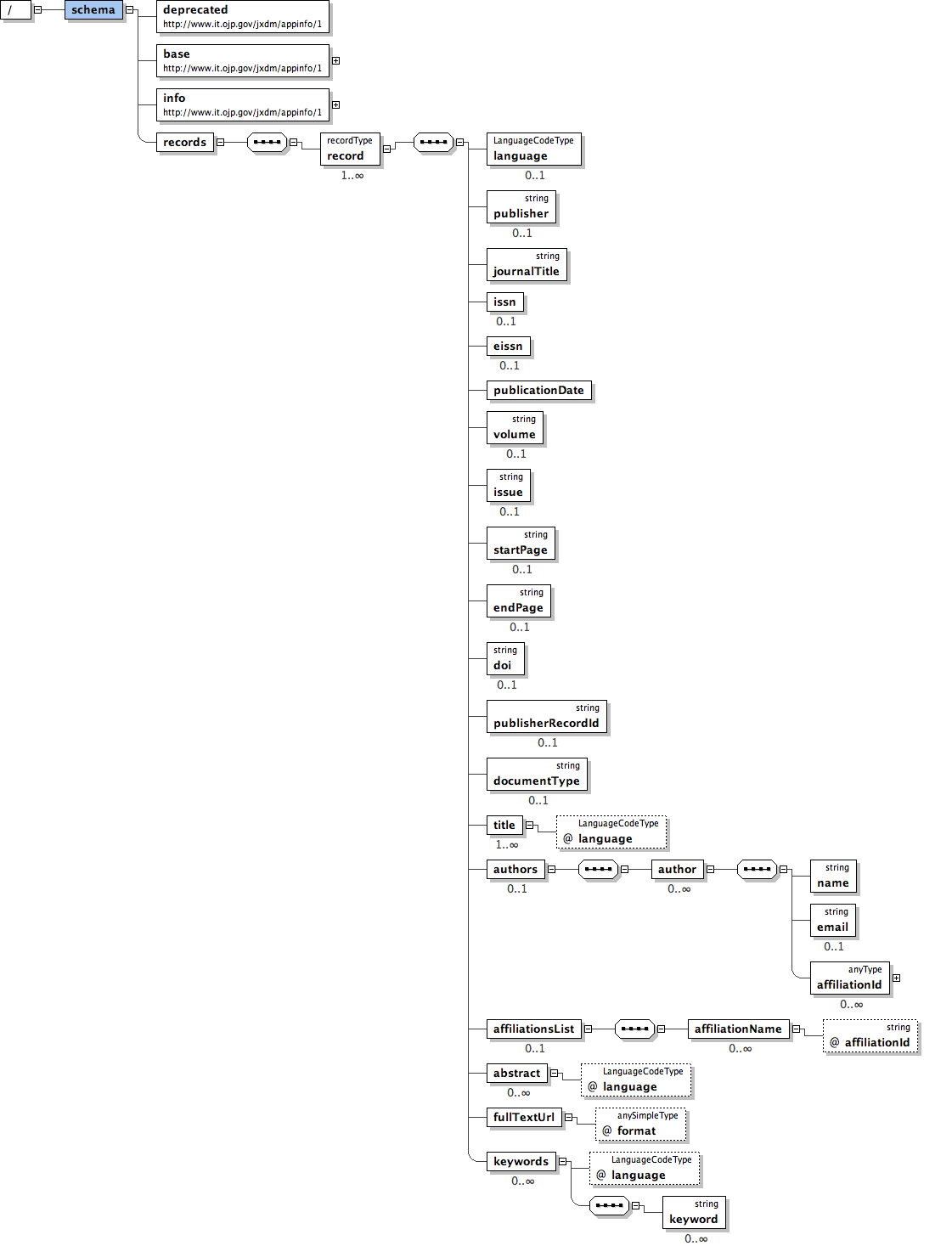 -- select thumbnail to see a larger version) includes elements for ISSN/eISSN, volume/issue, start/end page numbers, and author affiliation. There is also a
Article content using this schema is harvestable through the DOAJ OAI-PMH provider site (for instance, using a ListRecords verb with a doajArticle metadata prefix against the PMH URL). This is, in fact, the same schema journal publishers use to submit article content to the DOAJ article database. With these pieces in place, it is now conceivable to harvest open access journal article content through the DOAJ and add it to a local journal article repository (such as the Electronic Journal Center in the case of OhioLINK).
Thanks go out to the DOAJ folks for making this available!
